I have retired more AI tools than I’ve kept. Not because the ones I dropped were bad — most of them were perfectly good at the thing they promised.
They were just never going to be the thing I used.
And after enough of them, I noticed something uncomfortable: I almost never remember the brand names. What I remember, precisely and permanently, is why each one died. Which suggests the headstones were never the interesting part.
What Survived 🔋
Let me start with what’s alive, because that’s the verifiable half. The things I actually reach for:
- Codex — as a CLI, not a chat window. It lives in the terminal I’m already in.
- ChatGPT — desktop app, for the things that aren’t code.
- VS Code — with the two OpenAI extensions that put the first two within reach of the file I’m editing.
That’s not a claim that nothing else is installed on this machine. It’s a claim about what I open on purpose. There’s a difference, and the difference is the whole post.
Everything else in this piece is in the ground.
Cause Of Death #1: It Never Touched My Files 🪦
The first class of tool that dies here is the one that lives in a browser tab.
It can read what I paste in. It cannot read my repository, cannot see the file that’s actually wrong, cannot run anything. So every answer it gives is an answer to a description of my problem — and descriptions of problems are, by definition, written by the person who doesn’t yet know what the problem is.
That’s not a flaw in the tool. It’s a category error I kept making, paying for, and then blaming on the product.
Epitaph: Couldn’t see the code. Asked me to describe it instead.
Cause Of Death #2: It Was A GUI For A Command I Already Had 🪦
Some tools arrive as a friendly face over a shell command. That’s genuinely useful — right up until you already know the command.
At which point the friendly face is a layer between me and something that already worked, adding a click, a screen and an authentication flow to a command I could type in four characters.
Epitaph: Two keystrokes became eleven.
Cause Of Death #3: It Was Better At Starting Than Finishing 🪦
This one is the most common, and the most seductive.
A tool that produces an impressive first draft in seconds is deeply enjoyable to use. The trouble is that the enjoyable part is entirely front-loaded. Starting is cheap; finishing means being right, and being right is where the tool’s confidence stops being useful — because it will be equally fluent about the thing it got right and the thing it quietly made up.
Epitaph: Never wrong in the first sentence. Never finished in the last.
Cause Of Death #4: There Was No Exit 🪦
If my work only exists inside your product, then I’m not using your tool — I’m stored in it.
That’s the one I now check before I put real effort into anything: can I take the output with me in a form that still works if you disappear? Not “export as PDF.” The actual thing, in a format I own.
Epitaph: Left with everything, or it never stayed at all.
Cause Of Death #5: It Agreed With Me 🪦
The quiet one.
A tool whose default posture is to tell you that your plan looks good is not reviewing anything. It’s producing a reaction, and a reaction is calibrated to keep you talking.
I’ve thrown away work because a tool passed it, and I’ve kept work because a tool flattered it. Neither of those is judgement. The moment I noticed I was asking for opinions and receiving agreement, the tool was dead and I hadn’t admitted it yet.
Epitaph: Passed everything. Tested nothing.
The Five Gates 🚪
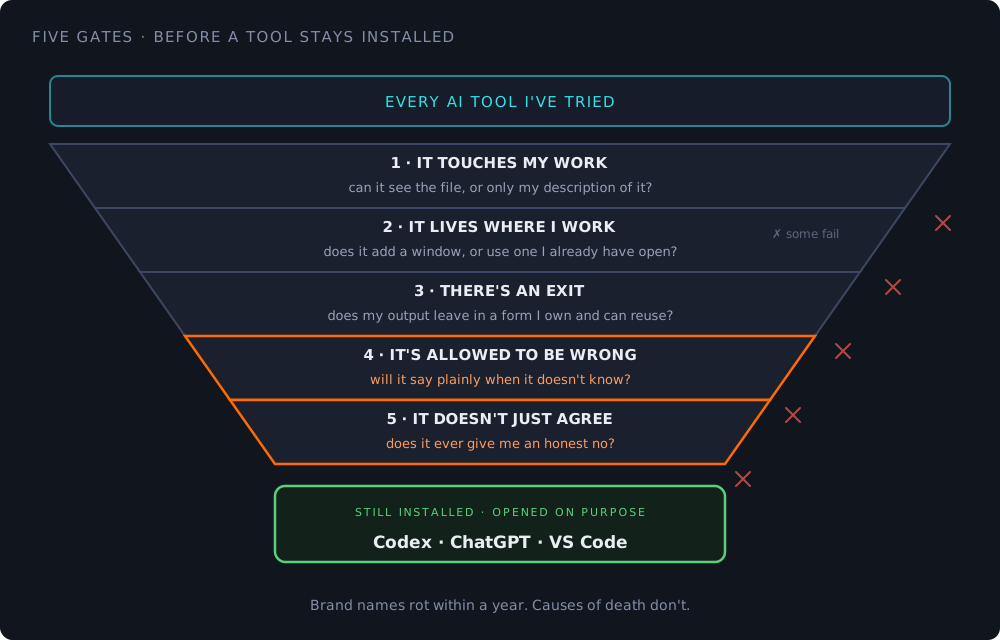
Those five causes of death, written in the positive, become a filter:
| # | The gate | The question |
|---|---|---|
| 1 | It touches my work | Can it see the actual file, or only my description of it? |
| 2 | It lives where I already am | Does it add a window, or use one I’ve open? |
| 3 | There’s an exit | Can my output leave in a form that still works without you? |
| 4 | It’s allowed to be wrong | Will it tell me plainly when it doesn’t know? |
| 5 | It doesn’t just agree | Does it ever make my week worse with an honest no? |
Gate 4 and gate 5 are the ones I’d defend hardest, and they’re the ones most tools quietly fail — because agreeing is cheap and being useful is expensive.
Why The List Of Names Was Never The Point ⚰️
Here’s what I keep coming back to.
If I’d written this post as a list of brands, it would have been wrong within a year. Names change hands, features get added, a tool that died for cause #3 comes back with a rewrite and deserves another look. A graveyard of names rots almost immediately.
Causes of death don’t rot. Tools will keep dying for those same five reasons for as long as the tools are new.
So the graveyard isn’t really a list. It’s a standing test — and the useful habit isn’t remembering who’s in the ground. It’s running anything new past the five gates before I invest a week in it.
Same posture I’ve kept all the way through the pipeline series: let the machine do the work it’s good at, keep the judgement, and never let enthusiasm substitute for a check. 🪦
What’s the last AI tool you retired — and which of those five reasons did it die of? I’d bet it’s #3 or #5. 👇