About
If you have ever felt like your computer was working against you,
this site is for you.
I used Windows since Windows 3.
I tried Linux four or five times over the years and it never stuck,
because every attempt began with a fresh install and ended with me
chasing tweaks I could not explain to anyone, including myself.
Then one evening I stopped reinstalling and started reading instead,
and it turned out the machine was never haunted.
It just had configuration left behind by somebody who had already left.
This site is that journey in three parts: getting the machine under control,
letting AI into the workflow without handing it the keys,
and documenting the plumbing that connects the two to the internet.
1 — The machine
Fedora, the terminal, and a long-running argument with my own config files.
An alias that ate a real command. A plugin that had been dead for months without anybody noticing. A file manager hunt that ended in precisely the room it started in. An upgrade that replaced 4,646 packages and did not touch a single directory name.
None of it is heroic. All of it is written down, because I will hit it again.
2 — Then the AI turned up
This is the part I am most careful about, because it is the part that is easiest to get badly wrong.
There is a way of working with a name now — vibe coding — where you describe roughly what you want and let the model decide the rest. I do not do that.
It works beautifully until the moment it stops, and when it stops you are the one holding a codebase you cannot read, made by something that cannot explain it to you. Fast is not the same as finished.
What I do instead is closer to supervision than delegation:
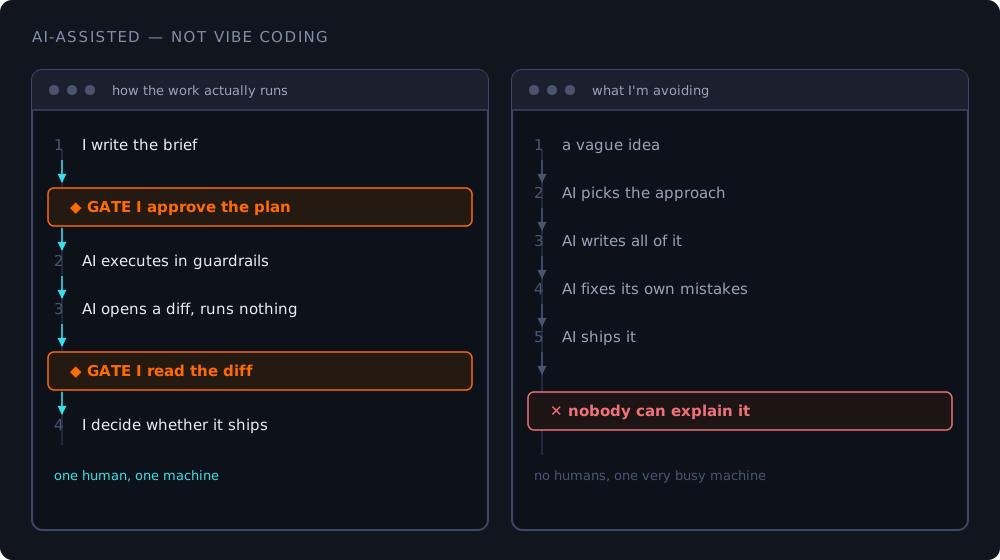
The difference is not speed — both are quick. The difference is who has to answer for it when it breaks, and on this site that is still me.
So the AI proposes and I approve. It executes inside guardrails I wrote first. It opens a diff rather than applying one. I read the diff. Then, and only then, does anything ship. The tools are genuinely useful — they are also on probation, permanently.
That stance is why the AI posts here are mostly about process: naming parallel threads so they stop talking over each other, sending four agents after one bug so they have to disprove each other, and auditing which of my tools are load-bearing and which are souvenirs I keep dusting.
3 — The plumbing nobody documents
This site is built by GitHub Actions and served by Cloudflare, and every layer between a markdown file and your screen has failed on me at least once.
The nameserver swap that broke nothing. The link preview that 404’d for months without anybody telling me. The publish chain that has to delete something before it can build. That is genuinely why those posts exist — I write them down because I am going to hit it again.
Where to start
There is no single correct order any more, so pick the problem you are currently holding:
If you are leaving Windows — From Lifelong Windows User to Happy Fedora Convert is the whole arc in one go, and My HP OMEN Install Story is the part where the hardware fought back.
If you want the terminal to stop feeling hostile — Windows PowerShell to Linux Terminal: Your Survival Guide is the entry point, then Starship, Micro & Fish is how mine grew a personality. Read The Day My Own Alias Bit Back afterwards, as a cautionary tale.
If you want to see the AI work under supervision — Three Codex Threads, Three Command Names is where parallel agents stop talking over each other, Sending A Squad After One Bug is where they earn their keep, and My AI Toolchain Graveyard is the honest audit of what survived. That last one is the one I would want read first if I were you.
If you only want to know how a blog reaches the internet — Netlify Builds It, Cloudflare Serves It, then Nobody Tells You Your Link Preview Is Broken, then From A Markdown File To A Reader’s Screen. All three are about the same website you are standing in.
One thing worth saying
Take it slow.
Calm comes from understanding, not from chasing speed.
None of this needs to be finished this week — I have been at it since December and I am still finding things out.
OwnYourStack.dev runs on : Astro Paper | Astro | Tailwind CSS | Cloudflare Workers | Github
Show your support
If you like my content Buy me a Coffee ⭐️.
Cheers! 🙏🏼